Overview

Mount San Cristobal is a potentially active stratovolcano situated at the boundary of the provinces of Laguna and Quezon on the island of Luzon in the Philippines. Rising to an elevation of 1,470 m (4,820 ft) above mean sea level, the mountain stands as one of the significant volcanic features of the Macolod Corridor. The volcano is geographically anchored by the municipalities of San Pablo in Laguna and Dolores in Quezon, marking a distinct topographical landmark in the region. Its status as an active volcano places it under the monitoring and governance of the Mounts Banahaw–San Cristobal Protected Landscape, which serves as the primary governing body for the area's ecological and geological preservation.

Geographical Context

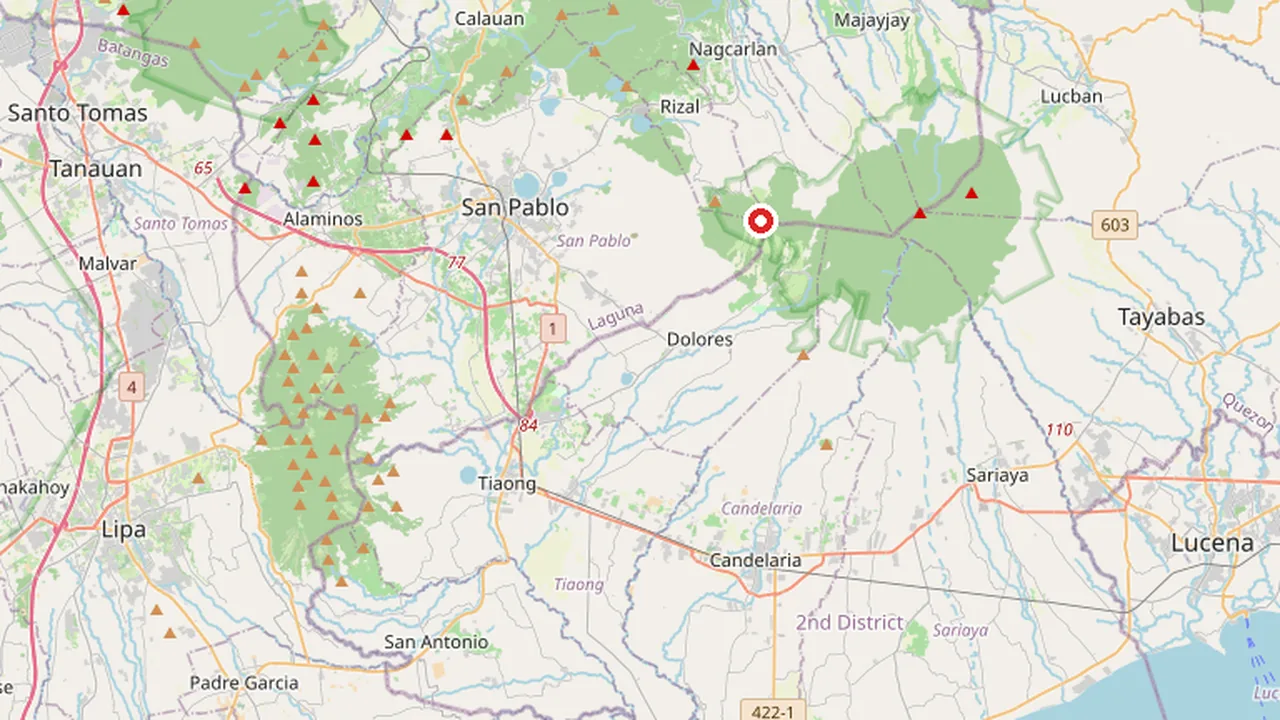
The volcano is located within the broader Luzon volcanic arc, contributing to the complex geological structure of the island. The coordinates 14.1167, 121.2331 pinpoint its central massif, which straddles the provincial line between Laguna and Quezon. This positioning makes Mount San Cristobal a shared natural heritage site for both provinces, influencing the local topography and drainage patterns of the surrounding municipalities. The Macolod Corridor, of which Mount San Cristobal is a key component, represents a vital ecological zone that connects various forest reserves and volcanic formations in southern Luzon.

Volcanic Classification

Classified as a stratovolcano, Mount San Cristobal exhibits the typical conical shape formed by numerous layers of hardened lava, tephra, pumice, and volcanic ash. Its designation as "potentially active" indicates that while it may not have erupted in recent historical memory, it retains the geological characteristics and subsurface activity consistent with active volcanic systems. This classification necessitates ongoing observation to assess potential seismic and thermal anomalies. The mountain's prominence in the region is not only geological but also ecological, supporting diverse flora and fauna within the protected landscape boundaries.

Geography and Geology

Mount San Cristobal is a potentially active stratovolcano located at the boundary of the provinces of Laguna and Quezon on the island of Luzon, Philippines. The mountain rises to an elevation of 1,470 m (4,820 ft) above mean sea level. It is one of the key volcanic features of the Macolod Corridor, a distinct geological formation in the region. The volcano is currently classified as active and falls under the governance of the Mounts Banahaw–San Cristobal Protected Landscape.

Geographic and Geological Statistics Value
Entity Type Volcano
Region Luzon
Provinces Laguna and Quezon
Municipalities/Cities San Pablo and Dolores
Coordinates 14.1167, 121.2331
Elevation 1,470 m (4,820 ft)
Status Active
Governing Body Mounts Banahaw–San Cristobal Protected Landscape

The Macolod Corridor is a significant volcanic feature in the Philippines, characterized by a series of volcanic cones and ridges. Mount San Cristobal is one of the prominent peaks within this corridor. The mountain's location at the boundary of Laguna and Quezon makes it a notable landmark in the region. The volcano is situated within the Mounts Banahaw–San Cristobal Protected Landscape, which helps preserve its natural and geological features.

History of Sacred and Demonized Landscapes

The historical narrative of Mount San Cristobal is defined by a profound cultural and spiritual transformation, shifting from an indigenous sacred landscape to a site of colonial demonization. Prior to the arrival of Spanish colonizers, the mountain held significant spiritual importance for the indigenous communities of Laguna and Quezon. As part of the broader Macolod Corridor volcanic system, the peak was viewed not merely as a geographical landmark but as a dwelling place for ancestral spirits and deities. The elevation of 1,470 m above mean sea level provided a vantage point that reinforced its status as a bridge between the earthly realm and the celestial, fostering a relationship of reverence and ritualistic offering among the local populations who inhabited the slopes of San Pablo and Dolores.

Colonial Reinterpretation and the "Devil's Mountain"

The Spanish colonial period introduced a radical reinterpretation of the mountain’s spiritual identity. Missionaries and colonial administrators, seeking to consolidate religious and political control, often categorized pre-Hispanic sacred sites as remnants of paganism or, more specifically, as domains of the Devil. Mount San Cristobal became known colloquially as the "Devil's Mountain," a label that served to delegitimize indigenous worship practices and encourage conversion to Christianity. This demonization was not unique to San Cristobal but was part of a broader strategy across Luzon to associate volcanic activity and rugged terrain with infernal forces, thereby framing the mountain as a place of trial and purification for the newly baptized.

The transition from sacred to demonized landscape did not erase the mountain's presence in local consciousness but rather layered new meanings onto existing beliefs. The volcanic nature of the stratovolcano, with its potential for activity, was interpreted through a Christian lens as the breath of the beast or the fires of purgatory. This narrative persisted for centuries, influencing local folklore and the way the mountain was perceived by subsequent generations. The mountain’s location at the boundary of Laguna and Quezon meant that it was subject to the influences of both provinces’ colonial histories, yet the overarching theme of spiritual conflict remained consistent.

Despite the colonial imposition of the "Devil's Mountain" moniker, the underlying reverence for the land endured in subtle forms. Indigenous practices often syncretized with Catholic traditions, resulting in a unique cultural landscape where the mountain was both feared and respected. The designation of the area as part of the Mounts Banahaw–San Cristobal Protected Landscape in modern times reflects a continued recognition of the mountain’s ecological and cultural significance, bridging the gap between its pre-colonial sacredness and its colonial-era demonization. This historical layering continues to shape the identity of Mount San Cristobal, making it a site of ongoing cultural and spiritual exploration for the people of Luzon.

What distinguishes Mount San Cristobal from Mount Banahaw?

Mount San Cristobal and Mount Banahaw are geographically and culturally intertwined, forming a dual peak system that defines the Macolod Corridor in Luzon. While both mountains rise from the boundary of Laguna and Quezon provinces, they are distinct stratovolcanoes separated by a saddle. Mount San Cristobal reaches an elevation of 1,470 m (4,820 ft) above mean sea level, standing as a potentially active volcanic feature. It is not a mere extension of its neighbor but a separate geological entity with its own volcanic history and topographic profile.

Joint Protection Status

The ecological and geological significance of both peaks has led to their joint conservation under the Mounts Banahaw–San Cristobal Protected Landscape. This governing body oversees the management of the volcanic complex, recognizing that the biodiversity and hydrological functions of the two mountains are interdependent. The protected landscape status ensures that conservation efforts, such as forest rehabilitation and watershed management, are applied holistically across both summits rather than in isolation. This administrative unity reflects the physical reality that the two volcanoes form a continuous volcanic ridge, influencing the local climate and ecosystem of the surrounding municipalities of San Pablo and Dolores.

Folklore and Cultural Identity

In Philippine folklore, Mount San Cristobal and Mount Banahaw are often portrayed as alter-egos or twin brothers, embodying different aspects of the region's mythological landscape. While Mount Banahaw is frequently associated with the legend of the "Golden Stairway" and the mythical city of Macabebe, Mount San Cristobal holds its own distinct place in local lore. The duality of these peaks is reflected in the cultural identity of the Laguna-Quezon borderlands, where the mountains are seen as guardians of the corridor between the Calabarzon region and Bicol. This cultural pairing reinforces the idea that the two volcanoes, though geologically distinct, are inseparable in the collective imagination of the local populace.

Conservation and Protected Status

Mount San Cristobal is a key component of the Mounts Banahaw–San Cristobal Protected Landscape, a designated conservation area that spans the boundary between the provinces of Laguna and Quezon. This protected landscape encompasses a total area of 10901 hectares, preserving the ecological integrity of the volcanic features within the Macolod Corridor. The establishment of this protected status aims to safeguard the biodiversity, geological formations, and hydrological systems associated with the potentially active stratovolcano and its neighboring peak, Mount Banahaw.

The conservation area is governed under the framework of the Mounts Banahaw–San Cristobal Protected Landscape, which integrates the natural resources management of both mountain ranges. This administrative unit ensures coordinated efforts in forest management, watershed protection, and ecological restoration across the two provinces. The protected landscape status recognizes the ecological significance of the region, which serves as a critical habitat for various flora and fauna species found in the Luzon highlands.

Conservation Statistics

Parameter Value
Protected Area Name Mounts Banahaw–San Cristobal Protected Landscape
Total Area 10901 hectares
Provinces Covered Laguna and Quezon
Key Features Mount San Cristobal and Mount Banahaw
Elevation of Mt. San Cristobal 1,470 m

The protection of this landscape is vital for maintaining the ecological balance of the Macolod Corridor, a region known for its diverse volcanic terrain. The 10901-hectare expanse includes various ecosystems, ranging from lowland forests to montane vegetation, supporting a rich array of biological diversity. Conservation efforts within this area focus on sustainable resource utilization, ensuring that the natural capital of Mount San Cristobal and its surroundings remains intact for future generations while accommodating the needs of local communities in San Pablo and Dolores.

Why it matters

Mount San Cristobal holds significant geological and cultural importance within the Philippine archipelago, primarily defined by its role in the Macolod Corridor and its deep roots in local folklore. As a potentially active stratovolcano, it is not an isolated peak but a critical component of a broader volcanic system that shapes the landscape of southern Luzon. The mountain rises to an elevation of 1,470 m (4,820 ft) above mean sea level, a height that contributes to the rugged topography of the boundary between Laguna and Quezon provinces. This geological positioning is central to understanding the region's volcanic history and future activity, as the Macolod Corridor is recognized as a distinct line of volcanic features. The presence of Mount San Cristobal helps define the structural integrity and volcanic potential of this corridor, influencing everything from local climate patterns to the geological composition of the surrounding municipalities, including San Pablo and Dolores.

Geological Significance in the Macolod Corridor

The Macolod Corridor is a notable volcanic range that stretches across the island of Luzon, and Mount San Cristobal is one of its key volcanic features. This classification is not merely academic; it has practical implications for hazard mapping and environmental management in the region. The volcano's status as potentially active means it remains under observation, contributing to the dynamic geological narrative of the area. The mountain's structure as a stratovolcano indicates a history of explosive eruptions and lava flows, which have shaped the valleys and ridges visible today. This geological activity has created a unique ecosystem that supports diverse flora and fauna, further enhancing the area's ecological value. The corridor itself serves as a geological bridge, connecting various volcanic centers and providing insights into the tectonic forces at play in the Philippine Mobile Belt. Understanding Mount San Cristobal's role within this system is essential for researchers studying volcanic evolution and for local communities planning for long-term resilience.

Cultural Symbolism and Syncretic Folklore

Beyond its geological attributes, Mount San Cristobal is a potent symbol in Filipino folklore, reflecting the syncretic nature of local beliefs. The mountain is often associated with spiritual significance, serving as a backdrop for myths and legends that blend indigenous animism with later religious influences. These stories are not just tales; they are integral to the cultural identity of the people living in Laguna and Quezon. The volcano is viewed as a living entity, a guardian of the land that demands respect and reverence. This perception influences local rituals and festivals, where the mountain is invoked for protection and prosperity. The syncretic folklore surrounding Mount San Cristobal demonstrates how natural landmarks become embedded in the social fabric of a community, shaping their worldview and practices. This cultural layer adds depth to the mountain's profile, making it more than just a geological formation but a sacred space that continues to inspire and unite the local population.

Administrative Boundaries and Local Context

Mount San Cristobal occupies a strategic geographical position at the administrative boundary between the provinces of Laguna and Quezon on the island of Luzon. The stratovolcano’s massif is divided primarily between two municipalities: San Pablo City in Laguna and the municipality of Dolores in Quezon. This trans-provincial location places the mountain within the broader Macolod Corridor, a significant volcanic feature in the region that includes Mount Banahaw and Mount Macolod. The elevation of the peak reaches 1,470 m above mean sea level, making it a prominent landmark visible from both provinces.

San Pablo City, Laguna

The western and southern flanks of Mount San Cristobal fall under the jurisdiction of San Pablo City. As the largest city in Laguna by land area, San Pablo has historically developed around the volcanic foothills. The city’s administrative boundaries encompass a significant portion of the mountain’s lower slopes and forested areas. San Pablo is known for its agricultural output and proximity to Lake Taal, but the presence of Mount San Cristobal defines its eastern topography. The municipality manages local access routes and community-based conservation efforts on its side of the range. Residents in San Pablo rely on the mountain for watershed protection and microclimate regulation. The city government coordinates with regional agencies to monitor volcanic activity and maintain infrastructure along the slopes.

Dolores, Quezon

The eastern and northern sections of the mountain lie within the municipality of Dolores in Quezon. Dolores is a first-class municipality located in the eastern part of the province. The terrain in Dolores is characterized by rolling hills and dense vegetation, with Mount San Cristobal serving as a key geographical anchor. The municipality’s administrative reach extends to the higher elevations of the volcano, where agricultural activities and forest management are common. Local communities in Dolores have long interacted with the mountain, utilizing its resources for farming and timber. The municipal government plays a role in preserving the ecological integrity of the slopes under its jurisdiction. Access to the summit from the Quezon side involves traversing rural roads and forest trails managed by local authorities.

Protected Landscape Status

Mount San Cristobal is part of the Mounts Banahaw–San Cristobal Protected Landscape. This protected area spans across both Laguna and Quezon, integrating the volcanic features into a unified conservation framework. The status as a protected landscape helps coordinate management efforts between the two provinces. It ensures that ecological resources, including forests and water sources, are preserved for future generations. The protected landscape designation also supports tourism and research activities, allowing visitors to experience the natural beauty of the volcano. Governance of the area involves collaboration between local government units and national environmental agencies. This cooperative approach helps address challenges such as deforestation, land use changes, and volcanic monitoring. The active status of the volcano requires ongoing assessment to ensure the safety of communities in San Pablo and Dolores.

Frequently asked questions

Where is Mount San Cristobal located?

Mount San Cristobal is a stratovolcano situated across the provinces of Laguna and Quezon in the island of Luzon, Philippines.

What is the volcanic status of Mount San Cristobal?

The mountain is classified as a potentially active stratovolcano, indicating that while it may not be erupting constantly, it retains the capacity for future volcanic activity.

What is the significance of the nickname 'Devil's Mountain'?

In Filipino folklore, Mount San Cristobal is often referred to as the 'Devil's Mountain,' reflecting local legends and cultural narratives that associate the landscape with demonic or sacred entities.

How does Mount San Cristobal differ from Mount Banahaw?

While both are prominent peaks in the region, the article distinguishes Mount San Cristobal from its neighbor Mount Banahaw through specific geological features, historical contexts, and unique folklore traditions.

What is the current conservation status of the mountain?

Mount San Cristobal holds a specific protected status aimed at conserving its ecological and geological features, which are significant for both local biodiversity and regional landscape preservation.

References

  1. "Mount San Cristobal" on English Wikipedia
  2. Department of Environment and Natural Resources (DENR)
  3. National Geographic Society - Mount San Cristobal
  4. Philippine Institute of Volcanology and Seismology (PHIVOLCS)